

Subsea Umbilical Cable Selection Guide
Hydraulic, Pneumatic & ROV Solutions
When Do You Need a Subsea Umbilical Cable?
A subsea umbilical cable is used when underwater systems require more than simple power and communication transmission. Unlike a standard ROV tether cable, an umbilical cable can integrate multiple functions, including electrical power, fiber optic communication, signal transmission, hydraulic lines and pneumatic tubes into a single customized cable assembly.
For inspection-class ROVs, a basic ROV cable may only need to provide power and data communication. However, advanced subsea systems such as work-class ROVs, subsea intervention tools and offshore equipment often require additional functions, including hydraulic power delivery or pneumatic control.
Typical applications requiring a subsea umbilical cable include:
· Work-class ROV systems requiring hydraulic power for manipulators, cutting tools and subsea equipment.
· Subsea intervention systems that combine power, communication and fluid transmission.
· Offshore inspection equipment requiring reliable signal and data transmission in harsh marine environments.
· Scientific and marine research systems requiring customized cable configurations for underwater operation.
By integrating multiple transmission elements into one cable structure, subsea umbilical cables reduce system complexity, improve reliability and provide a more compact solution for demanding underwater applications.
For complex ROV and subsea projects, customized configurations such as ROV Umbilical Cable, Hydraulic Umbilical Cable and Pneumatic Umbilical Cable can be designed according to operating depth, mechanical requirements and system functions.
Choosing the Right Umbilical Configuration
Selecting the right subsea umbilical cable depends on the functions required by the underwater system. Different applications may require different combinations of power, communication, fluid transmission and mechanical protection.
Application Requirement | Recommended Umbilical Configuration |
Power and data transmission for underwater vehicles | ROV Umbilical Cable |
Hydraulic power for subsea tools and manipulators | Hydraulic Umbilical Cable |
Air or gas transmission for control systems | Pneumatic Umbilical Cable |
Multiple functions including power, fiber, signal and fluid lines | Multi-Function Umbilical Cable |
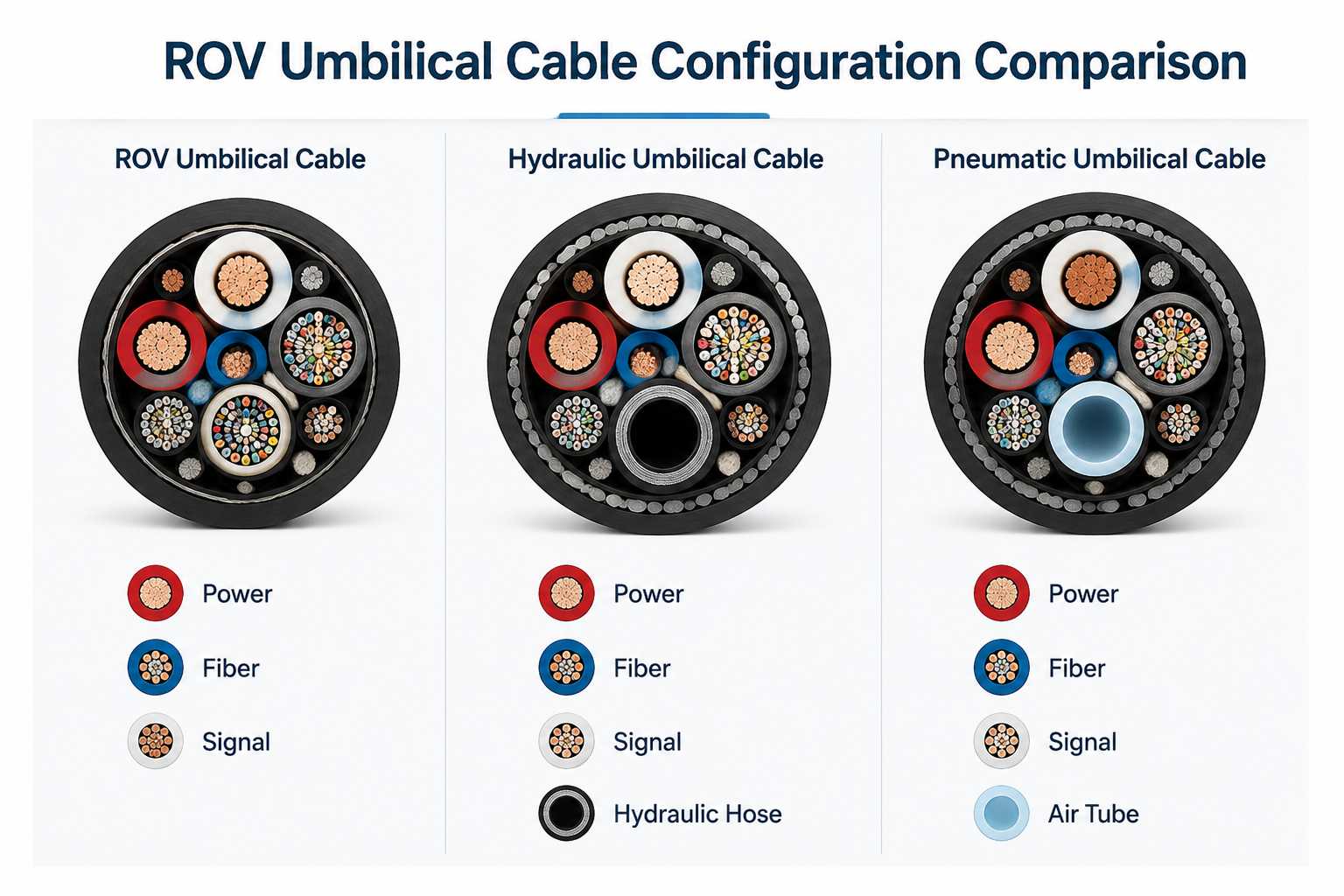
ROV Umbilical Cable
An ROV Umbilical Cable integrates power conductors, signal cores and fiber optics to provide reliable power and communication for underwater vehicles. It is commonly used for inspection ROVs, work-class ROVs and subsea robotic systems.
Hydraulic Umbilical Cable
A Hydraulic Umbilical Cable combines hydraulic hoses with electrical and optical elements for subsea equipment requiring fluid power transmission. It is widely used in work-class ROVs, subsea intervention and offshore operations.
Pneumatic Umbilical Cable
A Pneumatic Umbilical Cable integrates pneumatic tubes with power and communication elements for underwater systems requiring air or gas transmission, such as sensors, instruments and specialized subsea equipment.
The right umbilical configuration depends on application requirements, including power demand, communication needs, fluid transmission, operating depth and mechanical performance. Custom-designed umbilical cables can combine multiple functions into a single subsea solution.
Hydraulic Umbilical Cable for Subsea Intervention
Hydraulic power is essential for many subsea operations that involve mechanical tools, manipulators and intervention equipment. A Hydraulic Umbilical Cable integrates high-pressure hydraulic hoses with power conductors, fiber optics and signal cores to provide a compact connection between surface systems and underwater equipment.
Compared with standard ROV cables, hydraulic umbilical solutions provide additional fluid transmission capability for advanced subsea operations. They are commonly used in work-class ROVs, subsea construction, offshore intervention systems and remotely operated tools that require reliable hydraulic control.
The design of a hydraulic umbilical cable requires careful consideration of hose pressure rating, bending performance, tensile strength, operating depth and environmental protection. By combining multiple functions into one cable assembly, hydraulic umbilicals help simplify subsea system integration and improve operational reliability.
For customized configurations, see our Hydraulic Umbilical Cable solutions.
Pneumatic Umbilical Cable for Underwater Control Systems
Some underwater systems require air or gas transmission in addition to electrical power and communication. A Pneumatic Umbilical Cable integrates flexible pneumatic tubes with power conductors, signal cores and fiber optic elements to support reliable control and monitoring functions.
Compared with hydraulic systems, pneumatic configurations are typically used for applications requiring lightweight fluid transmission, air-powered control or specialized underwater instrumentation. Typical applications include inspection ROVs, subsea sensors, scientific equipment and marine monitoring systems.
Pneumatic umbilical cable design focuses on air-tightness, flexibility, mechanical protection and long-term performance in underwater environments. Custom configurations allow different combinations of pneumatic tubes, electrical conductors and communication elements according to project requirements.
For specialized underwater applications, explore our Pneumatic Umbilical Cable solutions.
Custom Multi-Function Umbilical Cable Design
Complex subsea systems often require multiple transmission functions within a single cable assembly. A Multi-Function Umbilical Cable combines power, fiber optics, signal transmission, hydraulic hoses and pneumatic tubes into one customized solution to reduce system complexity and improve operational reliability.
Depending on the application requirements, different elements can be integrated, including:
Electrical power conductors for equipment operation
Fiber optic channels for high-speed data communication
Signal cores for control and monitoring
Hydraulic hoses for subsea tools and intervention systems
Pneumatic tubes for air or gas transmission
Custom umbilical cable design requires careful consideration of operating depth, tensile strength, bending performance, outer diameter, buoyancy requirements and environmental conditions. By optimizing the internal structure and material selection, manufacturers can develop reliable cable solutions for ROV systems, offshore equipment and underwater applications.
For projects requiring combined power, data and fluid transmission, our Multi-Function Umbilical Cable solutions provide flexible configurations tailored to specific operational requirements.
Need a customized subsea umbilical cable for your ROV or underwater system?

Post time:2026-07-16
