

ROV Umbilical Cable

ROV Umbilical Cable
RouLine is a custom ROV umbilical cable manufacturer, designing and manufacturing ROV Umbilical Cables for demanding subsea operations, integrating power conductors, signal pairs, optical fibers, shielding, and tensile reinforcement into project-specific cable configurations.
RouLine ROV umbilical cables can be customized with flexible copper conductors, anti-twist core structures, Kevlar tensile members, and durable polyurethane sheaths to meet requirements for mechanical strength, flexibility, signal integrity, and reliable performance in harsh underwater environments. Hydraulic Lines, Pneumatic Tubes, and other functional components can also be integrated according to your system design.
From conductor size and fiber count to cable length, voltage rating, and protective construction, each cable can be configured to meet your ROV system requirements and deployment conditions.


Custom Cable Solutions | Flexible MOQ | Fast Lead Time |
Key Features
Rated Voltage: 3.6/6 kV to 12/20 kV for applicable medium-voltage configurations.
Conductor Size: 1.5–120 mm², flexible Class 5 copper conductors.
Shielding: Tinned copper braid providing 360° EMI/RFI shielding.
Fiber Optic: 6–24 single-mode or multimode optical fibers.
Kevlar Reinforcement: Central Kevlar core and interstitial Kevlar filler for additional tensile support.
PUR Outer Sheath: Extruded polyurethane (PUR) sheath for demanding subsea environments.
Torque-Balanced Construction: Balanced armor and anti-twist construction for improved torsional stability.
Environmental Protection: Individual zinc and polymer coating on steel wires for protection against seawater and corrosive environments.
Integrated Functions: Optional Hydraulic Lines, Pneumatic Lines, strain gauges, and bend restrictors.
Specifications
Parameter | Specification |
Cable Type | ROV Umbilical Cable |
Conductor | Tinned copper, Class 5 flexible copper |
Conductor Standard | IEC 60228 |
Conductor Cross-Section | 1.5–120 mm² |
Insulation | EPR , DPEM , TPE, XLPE, |
Core Structure | Anti-twist layering, grouped gap filling, twisted pairs, layered binding |
Optical Fiber | Single-mode / Multimode, 6–24 fibers |
Shielding | Tinned copper braid, 360° EMI/RFI shielding |
Tensile Member | Central Kevlar core and interstitial Kevlar filler |
Outer Sheath | Extruded polyurethane (PUR) |
Rated Voltage | 300V ~ 1 kV (for higher voltage, please contact) |
Insulation Resistance | ≥20 MΩ·km at 20°C |
Operating Temperature | −30°C to +90°C |
Hydraulic Lines | Optional |
Pneumatic Lines | Optional |
Strain Gauges | Optional |
Bend Restrictors | Optional |
Length Marking | Customized |
We offer solutions tailored to specific customer requirements.

Applications
RouLine ROV umbilical cable is designed for demanding subsea and marine applications, including remotely operated vehicle (ROV) operations, offshore engineering, underwater inspection, and deep-sea exploration.
These ROV cables integrate power conductors, control and signal cores, data transmission, and optional fiber optic elements, with steel wire armor or other reinforcement structures to provide enhanced tensile strength, mechanical protection, and reliable performance in deepwater deployment, cable handling, and continuous subsea operations.
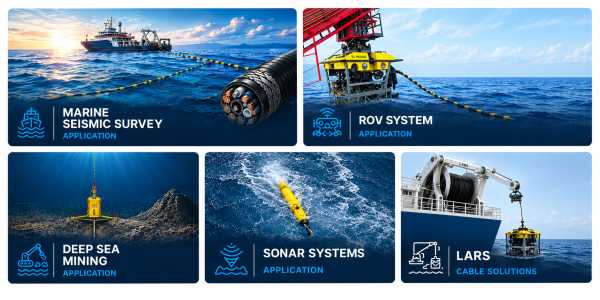
↗Marine Seismic Survey Systems


Quality Testing & Control | Manufacturing Process |
Manufacturing Process
RouLine industrial cable manufacturing process covers conductor preparation, insulation and sheath extrusion, reinforcement, cable assembly, and final testing and inspection. As a custom industrial cable manufacturer, RouLine adapt cable structures, materials, and production processes to meet specific electrical, mechanical, and environmental requirements. The following stages demonstrate our manufacturing capabilities and quality control procedures for reliable industrial cable solutions.


→Cable Core Assembly Process →Wire Stranding Process →Kevlar Braiding Process
Explore our industrial cable manufacturing process through real, on-site videos filmed directly in our production workshop. These videos show the actual manufacturing of different cable types, from conductor processing and insulation extrusion to cable assembly, reinforcement, and final inspection. Get an inside look at our custom industrial cable production capabilities, manufacturing equipment, and quality control procedures for marine, subsea, mining, and other demanding industrial applications.
More Videos of ROV Cable Manufacturing →
Test Equipment
Industrial cables manufactured by RouLine are inspected using dedicated equipment for electrical, mechanical, and environmental testing. Depending on the cable design, testing may include high-voltage testing, insulation and continuity checks, tensile testing, flexing, temperature-humidity, salt-spray, and dimensional inspection. Testing procedures can be defined according to cable construction, operating depth, voltage rating, mechanical requirements, and applicable standards. →View the Test Equipment in Use

Ordering Information
Standard Lead Time: 3-6 weeks after order confirmation
Customization: Fully supported
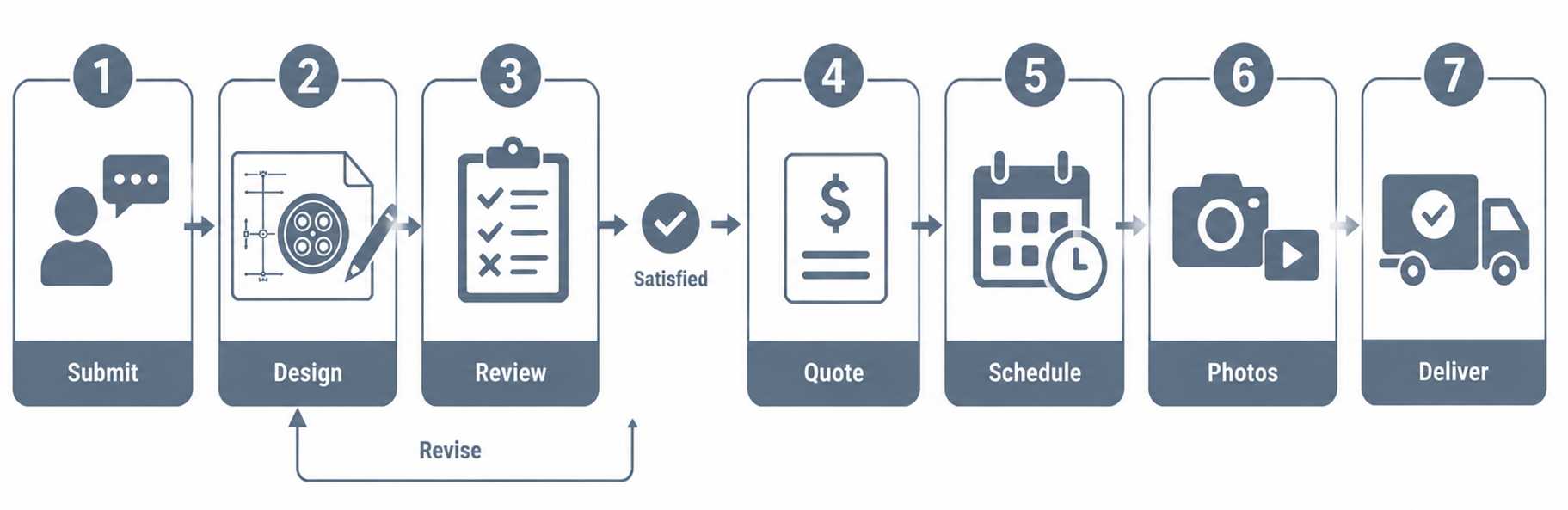
Custom Development Process
Engineering Insight
→ Explore Subsea Umbilical Cable Manufacturing Insights
FAQs
1. What is an ROV umbilical cable used for?
An ROV umbilical cable connects remotely operated vehicles to surface control equipment or other subsea systems. It transmits power, control signals, data, and optional fiber optic communications while providing the mechanical strength required for underwater deployment.
2. Can ROV umbilical cables be customized for different ROV systems?
Yes. A custom ROV umbilical cable can be tailored to conductor size, core arrangement, fiber count, shielding, tensile reinforcement, sheath material, and cable length. Hydraulic or pneumatic lines can also be integrated according to project requirements.
3. Can an ROV umbilical cable combine power conductors and fiber optic communication?
Yes. A hybrid ROV umbilical cable can integrate copper power conductors, signal cores, and single-mode or multimode optical fibers. This configuration supports electrical power and high-bandwidth data transmission through a single cable assembly.
4. What materials are used in ROV umbilical cable construction?
Typical ROV umbilical cable construction includes flexible copper conductors, EPR or XLPE insulation, tinned copper braid shielding, Kevlar tensile members, and a PUR outer sheath. Materials and structures are selected according to flexibility, mechanical strength, and subsea operating conditions.
5. How is the tensile strength of an ROV umbilical cable determined?
The required tensile strength depends on cable length, suspended weight, operating depth, vessel movement, and deployment conditions. Kevlar reinforcement or steel wire armor can be selected according to the required mechanical protection and load capacity.
6. What voltage ratings and conductor sizes are available for ROV umbilical cables?
Custom ROV umbilical cables can be designed with conductor cross-sections from 1.5 to 120 mm², depending on the configuration. This product specification covers 300 V to 1 kV, with higher-voltage designs subject to engineering review.
7. How do I choose an ROV umbilical cable manufacturer?
Choose an ROV umbilical cable manufacturer with custom design and manufacturing capabilities suited to your project. Provide the required cable length, operating depth, voltage, conductor size, fiber count, tensile load, and deployment method to determine the appropriate cable configuration.


