

Reeling Cable, 6/10kV

Reeling Cable
Optical Fiber, Round Type Medium Voltage 6/10kV
Reeling Cable is an industrial cable designed for cable reel systems that require continuous winding and unwinding as equipment travels. It is widely used in port and container handling equipment, including ship-to-shore (STS) cranes, rubber-tyred gantry (RTG) cranes, and rail-mounted gantry (RMG) cranes, as well as ship unloaders, stacker-reclaimers, and other bulk material handling equipment.
The cable designs adapted to repeated bending, tensile loads, and, where applicable, torsional stress. In port and coastal environments, reeling cables may also need to withstand humidity, salt-laden air, and other demanding operating conditions.
As a custom reeling cable manufacturer, RouLine supply power reeling cables and medium voltage reeling cables configured for different travel distances, operating voltages, reel systems, and installation conditions. Conductor configurations, insulation, reinforcement, and outer sheath materials can be tailored to the mechanical and environmental requirements of each application.


Custom Cable Solutions | Flexible MOQ | Fast Lead Time |
Key Features
Hybrid Cable Power, Control, Optical Fiber (3in1)
High Flexibility Continuous reeling & bending
Harsh Environmental Resistance UV, ozone, hydrolysis & moisture resistant
Mechanical Strength Resistant to tensile stress, pressure & abrasion
Marine Ready Saltwater & corrosive coastal environments
High Travel Speed Up to 120 m/min
High Tensile Capacity Approx. 15 N/mm²
Corrosion Resistant Designed for harsh, humid environments
Certified Quality VDE 0250 P813 & MT818
Specifications
Parameter | Specification |
Voltage Rating | 6/10 kV |
Conductor | Class 5 Copper, compliant with IEC 60228 |
Insulation | Inner Semiconducting Layer + Specially Formulated EPR (Ethylene Propylene Rubber) + Outer Strippable Semiconducting Layer |
Grounding Core | Semiconductor Material |
Control Core | TPEE, 1.5–2.5 mm², 2–6 Cores |
Core Structure | 3+3 (Optimal Lay Length Stranding) |
Inner Sheath | TMPU |
Torsion-Resistant Layer | Aramid Fiber Braid |
Outer Sheath | TMPU |
Color | Red |
Optical Fiber | Single-Mode E9/125; Multi-Mode 62.5/125 |
Working Temperature | Reel-Based Installation: −30°C to +80°C; Fixed Installation: −40°C to +90°C |
Test Voltage | 21 kV |
Minimum Bending Radius | 12 × Cable Outer Diameter (OD) |
Flame Retardant | IEC 60332-1 |
Standard | VDE 0250 P813; MT 818 |
Compliance | RoHS |
No. of Cores × Cross Section | OD (mm) | Copper Weight (kg/km) | Cable Weight (kg/km) |
3×70+2×25+(6×2.5)C+6D | 63 | 2533 | 6203 |
3×95+2×25+(6×2.5)C+6D | 65 | 3273 | 7230 |
3×120+2×25+(6×2.5)C+6D | 70 | 4203 | 8581 |
We offer solutions tailored to specific customer requirements.

Applications
Reeling cables are widely used in industrial cable reel systems that require reliable power transmission during long-distance equipment travel and repeated winding and unwinding. Typical applications include port cranes, container handling systems, ship unloaders, stacker-reclaimers, and large-scale bridge cranes, as well as bulk material handling equipment and other mobile industrial machinery.
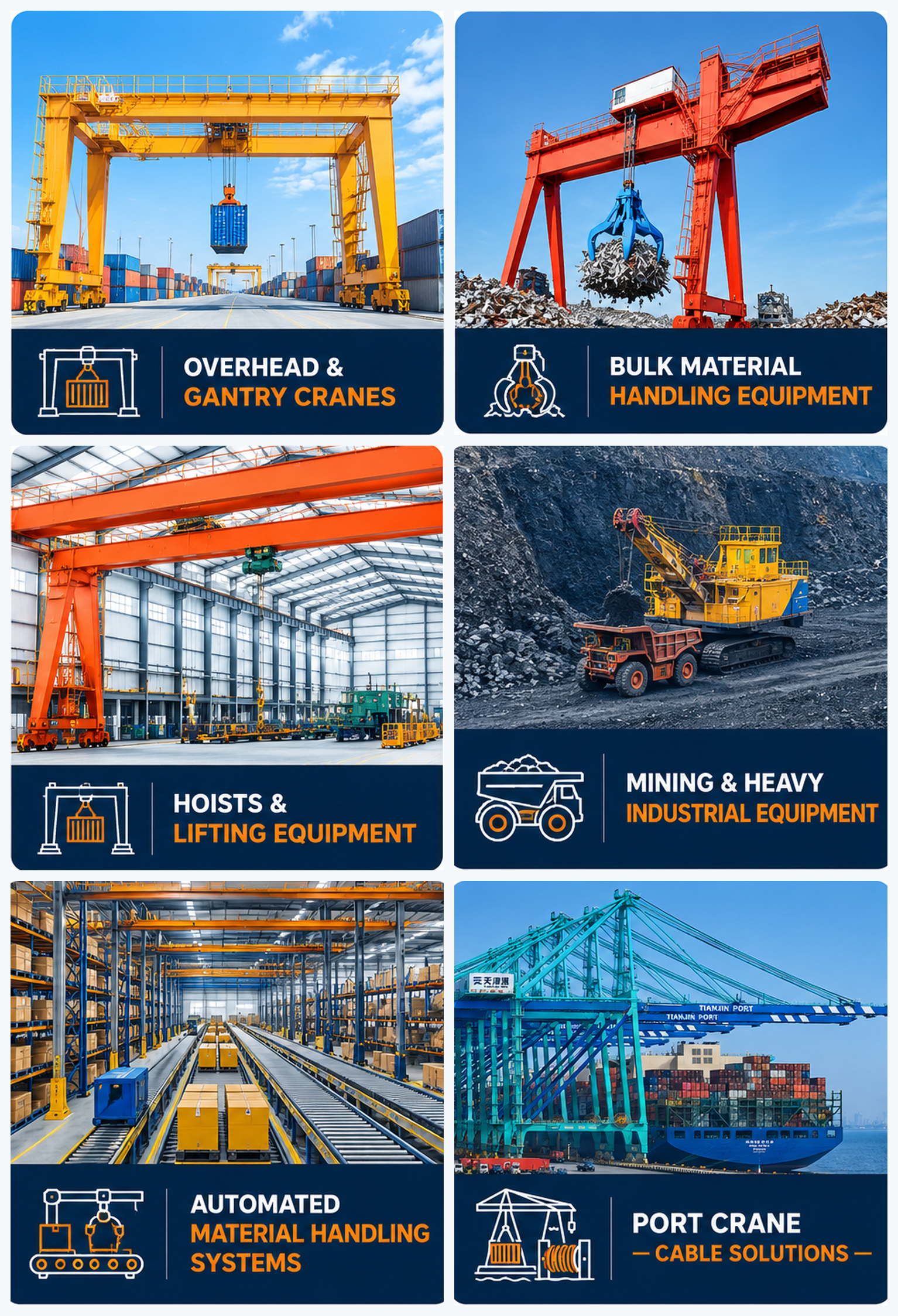
Depending on the operating environment, reeling cable solutions can be configured for medium voltage power supply, continuous mechanical movement, and demanding outdoor conditions in ports, terminals, mining facilities, and industrial plants. The following applications illustrate how custom reeling cables support different equipment configurations and operating requirements.
↗ Port Cranes & Container Handling
↗ Overhead & Gantry Cranes
↗ Bulk Material Handling Equipment
↗ Hoists & Lifting Equipment
↗ Automated Material Handling Systems
↗ Mining & Heavy Industrial Equipment
Case Study
A custom reeling cable solution engineered for Tianjin Port crane system, power transmission, high dynamic flexibility, tensile strength, and marine environmental resistance.

Reeling Cable Project for Tianjin Port


Quality Testing & Control | Manufacturing Process |
Manufacturing Process
RouLine industrial cable manufacturing process covers conductor preparation, insulation and sheath extrusion, reinforcement, cable assembly, and final testing and inspection. As a custom industrial cable manufacturer, RouLine adapt cable structures, materials, and production processes to meet specific electrical, mechanical, and environmental requirements. The following stages demonstrate our manufacturing capabilities and quality control procedures for reliable industrial cable solutions.


→Cable Core Assembly Process →Wire Stranding Process →Kevlar Braiding Process
Test Equipment
Industrial cables manufactured by RouLine are inspected using dedicated equipment for electrical, mechanical, and environmental testing. Depending on the cable design, testing may include high-voltage testing, insulation and continuity checks, tensile testing, flexing, temperature-humidity, salt-spray, and dimensional inspection. Testing procedures can be defined according to cable construction, operating depth, voltage rating, mechanical requirements, and applicable standards. →View the Test Equipment in Use

Ordering Information
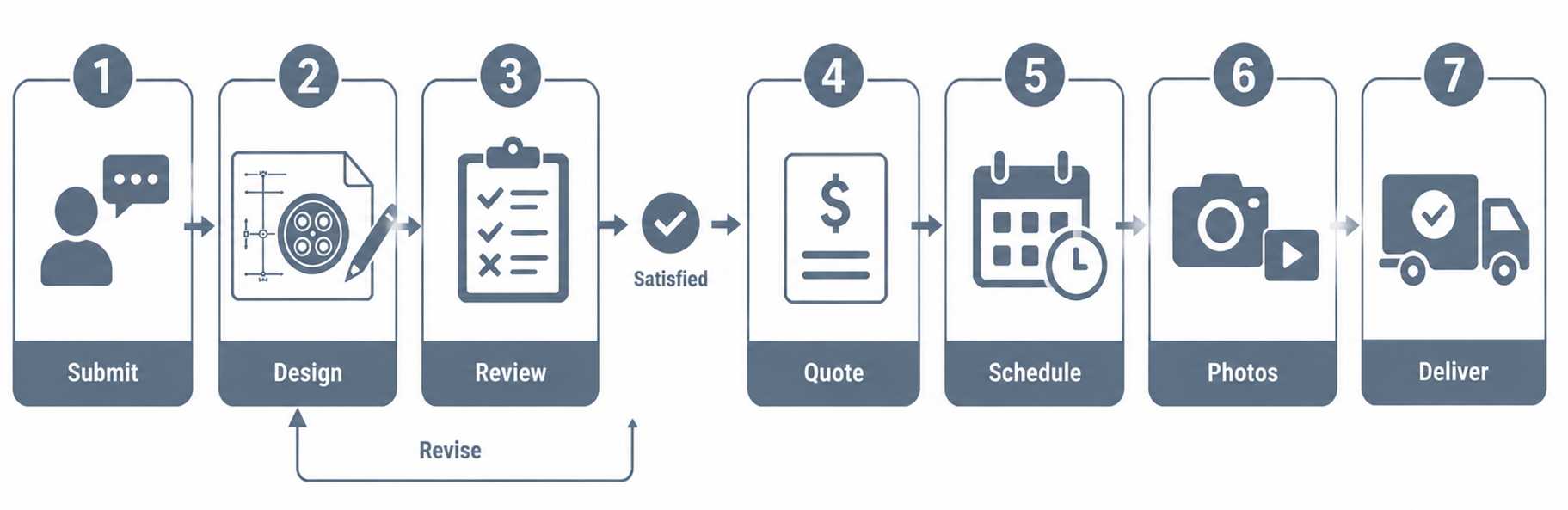
Customization: Fully supported
MOQ: project-based negotiation
Standard Lead Time: 4-7 weeks after order confirmation
Custom Development Works
FAQs
1. What is a reeling cable used for?
Reeling cables are used in cable reel systems on cranes, ship unloaders, stacker-reclaimers, and other mobile industrial equipment requiring reliable power transmission during repeated winding and unwinding.
2. Which industrial applications require reeling cables?
Reeling cables are commonly used in port cranes, ship-to-shore cranes, rubber-tyred gantry cranes, rail-mounted gantry cranes, ship unloaders, stacker-reclaimers, and bulk material handling systems.
3. What should be considered when selecting a reeling cable?
Key factors include operating voltage, cable travel distance, reeling speed, bending radius, tensile load, torsional stress, installation method, and environmental conditions. These factors help determine the appropriate cable structure and materials.
4. Which materials are used for reeling cable insulation and sheathing?
Reeling cables can use materials such as EPR, rubber, PUR, or other specially formulated compounds, depending on voltage rating, flexibility, abrasion resistance, temperature range, and operating environment.
5. Can reeling cables be customized for port cranes and bulk material handling equipment?
Yes. Custom reeling cables can be configured with different conductor sizes, power and control cores, voltage ratings, reinforcement layers, and outer sheath materials to meet specific equipment and operating requirements.
6. Are reeling cables suitable for humid and salt-laden coastal environments?
Yes, when designed with suitable insulation, protective sheathing, and mechanical reinforcement. Reeling cables for ports and coastal facilities should be selected to withstand moisture, salt-laden air, repeated movement, and other site-specific conditions.
7. What is the difference between reeling cables and festoon cables?
Reeling cables are wound onto and unwound from cable drums, while festoon cables are typically suspended on trolleys along a track. The choice depends on the equipment's cable management system, travel path, and movement requirements.


